KARACHI DROWNING IN POISON: THE DEADLY WATERCRISIS THREATENING MILLIONS
- ckinitiative
- Nov 2, 2025
- 5 min read
Updated: Dec 18, 2025
By: Ria Manghnani (CKI Researcher)
Karachi’s water crisis is nothing short of a severe emergency, threatening the health and survival of millions of residents every day. Rivers, canals, and pipelines—once sources of life—are now poisoned with industrial waste, untreated sewage, and hazardous chemicals, turning water into a vehicle for disease and death. This catastrophe is fueled by decades of neglect, unchecked industrial pollution, failing sanitation systems, and uncontrolled city expansion. The city’s most vulnerable—those in informal settlements and low-income neighborhoods—suffer the heaviest consequences of this toxic reality, exposing glaring social and economic inequalities. Confronting Karachi’s water pollution demands immediate, bold action: systemic reforms, sustainable urban planning, and community-driven initiatives are essential to restore the city’s vital water resources and protect its people before it’s too late.

Toxic Streams: The Forces Behind Karachi’s Water Emergency
Karachi’s water crisis is rooted in shifting supply systems, weak governance, and unchecked urban-industrial growth. Once dependent on wells and aquifers, the city shifted in the 1950s to the Indus River and Keenjhar Lake, overseen by agencies that evolved into the Karachi Water & Sewerage Board (1983) and later the Karachi Water & Sewerage Corporation (2023). Rapid urban expansion, including informal settlements and elite housing along natural drainage nullahs, has disrupted water flows and increased flood risks. Meanwhile, more than 10,000 industries discharge untreated effluents into the Lyari and Malir rivers, leaving Karachi’s coastline among the most polluted in Pakistan. Fragmentation between KWSC, the Sindh Irrigation Department, and the Sindh Environmental Protection Agency has worsened inefficiency, with up to 60% non-revenue water and chronic underinvestment despite World Bank estimates of $2.5 billion needed by 2030. Politically, the 1991 Water Apportionment Accord heightened disputes, with Sindh alleging that Punjab extracts more than its allocated share of the Indus, diminishing downstream flows and worsening scarcity in Karachi.

This chart exposes a shocking reality: the Lyari and Malir Rivers are drowning in untreated wastewater, with the Lyari surging past 200 MGD and the Malir over 80 MGD. Overflowing with sewage, industrial effluents, and toxic waste, these rivers are suffocating, devastating ecosystems, spreading disease, and threatening the health of millions who live along their banks. This is an urgent cry for action—without immediate and effective wastewater treatment, Karachi’s lifelines will collapse, leaving behind ecological ruin, public health crises, and a stark reminder of humanity’s neglect.
Voices from the Ground: The Human Toll of Karachi’s Water Crisis Karachi’s water crisis is not just a policy failure—it is a daily struggle for its residents. In neighborhoods like Orangi Town, families rely on water tankers, often paying exorbitant prices for a basic necessity; one resident shared, “There is a small amount of water. I am saving it to drink. When I have money, I’ll get a tanker”. In coastal communities such as Rehri Goth, inadequate infrastructure and reliance on informal water sources leave residents vulnerable to waterborne diseases and economic exploitation. Similarly, the fishing community on Baba Island faces isolation during monsoon seasons, with limited access to clean water and healthcare, highlighting the intersection of environmental degradation and public health challenges. These real-life experiences underscore the urgent human cost of Karachi’s water crisis and the need for immediate systemic reforms.
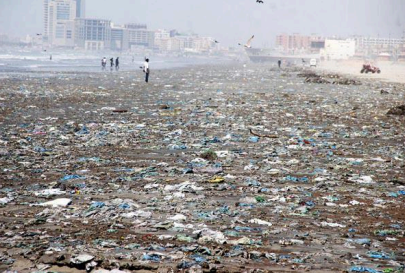
The image captures a haunting reality: Karachi’s shores, once places of respite and beauty, now suffocated under mountains of plastic, sewage, and industrial waste. This toxic blanket is not just an eyesore—it is a silent assault on the people of the city. Fishermen who once depended on the sea for their livelihoods now haul in nets tangled with garbage instead of fish, while children from nearby settlements play along beaches poisoned with pathogens.. Contaminated water seeps into homes, fueling outbreaks of cholera, hepatitis, and skin infections, disproportionately devastating Karachi’s poor, who cannot afford bottled water or private healthcare. This is not just pollution—it is neglect turned into violence, a systemic failure that steals clean air, safe water, and the very right to live with health and dignity.
Corruption in Every Drop: The Human Cost of Karachi’s Water Crisis
The root causes of Karachi’s water pollution are deeply embedded in political patronage, economic neglect, and social inequality. Corruption and mismanagement plague the Karachi Water & Sewerage Board (KWSB), where theft, illegal hydrants, bribery, and revenue loss hamper delivery of safe water, especially for low-income areas. Institutional neglect is evident in aging pipelines, parallel sewage lines, and treatment plants that are either non-functional or underfunded—only two of three sewage treatment plants are fully operational, leaving vast volumes of sewage discharged untreated into rivers and the sea. Politically powerful actors, including the “water mafia,” benefit from these failures: they divert water supplies through illegal pumping stations and private tankers, often linked with local political elites, selling scarce water at high cost, while formal systems fail. Meanwhile, social disparities exacerbate the harm: poorer neighborhoods receive only a fraction of promised supply, suffer disproportionate exposure to contaminated water, and bear the health burdens of waterborne diseases like diarrhoea, typhoid, and hepatitis.

This water treatment plant is the frontline in Karachi’s battle against pollution—a fortress where poisoned waters are transformed into life-giving streams. Every tank, every filter, every turbine roars with defiance against years of neglect, turning despair into hope. Here, corruption and contamination meet relentless human resolve, proving that even the darkest waters can be cleansed with courage, science, and sheer will. This is more than a plant—it is Karachi’s heartbeat, a bold declaration that our city will no longer drink its own destruction.
Rising Waters, Rising Voices: Karachi’s Battle for Survival
In the face of Karachi’s water crisis, a surge of resilience and innovation is rising from the heart of the city. Youth-led initiatives are transforming despair into action, proving that the future of Karachi lies in the hands of its young citizens. From university students collaborating with the Prime Minister's Green Youth Movement to conduct impactful sustainable activities, to grassroots organizations installing water filtration plants in underserved communities, the youth are not waiting for change—they are creating it. The World Bank's $240 million investment in Karachi's water and sanitation infrastructure underscores the importance of youth engagement, with 58% of beneficiaries being young people aged 15–24. Karachi’s fate now rests in the hands of its young leaders to lead with innovation, and to demand accountability from those in power. The path forward is clear: empower the youth, support grassroots movements, and implement policies that prioritize sustainable water management. Karachi's water crisis is not just a challenge—it is an opportunity for its young citizens to rise, lead, and transform their city into a beacon of hope and resilience.
Karachi’s water crisis is not merely a tale of pipes and pumps—it is a story of neglect, resilience, and the relentless fight for survival. Decades of mismanagement and corruption have left the city parched, yet in the midst of despair, hope rises through the courage of its youth, the determination of grassroots movements, and the sparks of reform that refuse to be extinguished. The battle for clean water is a battle for life itself, for dignity, for the future of a generation that will no longer accept compromise. Karachi stands at a crossroads: it can continue to drown in apathy, or it can rise, fierce and united, to reclaim what is rightfully its own. The choice is ours—and the time to act is now.
SOURCES:

Comments